Thursday, September 17, 2020

Winterizing Tips


Water (freezing water) will do considerable damage. Freezing water can break thru hull valves, raw water strainers, engine blocks, fresh water systems, marine heads and porta-potties, and anything else that has water in it during the winter.

So, here is a typical check list of things to do aboard your boat to make sure that she’s ready for winter.

The first thing to do is to check the owner’s manuals for equipment aboard your boat.  Are there specific recommendations for winter conditions?

Next prepare a written checklist so that you will cover all the “bases”……  Here are some of the “bases”…

Clean out the boat.

Remove all electronic equipment and store it in a warm dry place.  Check your owner’s manual for info on how to store this gear.

Remove all sails, lines, anchors, fenders, pfd’s, bunk cushions, flares, fire extinguishers, carpets, etc.  Check and repair these over the winter.

Empty all lockers, especially food lockers.  Take all loose gear off the boat.

Securely prop open all locker doors, access hatches, bilge access and anything else that will improve air circulation.

Open and clean the ice box and/or refrigerator.

Drain all the water from the fresh water system.

For a fairly simple system, drain all the hoses and drain and clean the tanks.  Leave everything empty.

For more complicated systems with heaters and electric pumps you’ll need to empty all water, header and heater tanks, making sure that no water remains in the tanks below the outlet level.  Clean the tanks and wipe internally with a chlorine solution.

Make sure you disconnect the electrical supply to the heater tank before you drain it.

Drain all the water from the hoses and pumps – you may need to disconnect hoses at both ends to do this.

Reconnect the hoses ad bypass the water tank.  Pump pink, eco-friendly anti-freeze into the hoses and pumps to protect them from any residual water.

Check shower sump for water.  Sponge dry if necessary.

Drain and winterize the head.

Pump out the holding tank.  Flush the head with fresh water several times while emptying the holding tank.

Close the head intake seacock and romove the hose.  Sit the hose in a bucket of 50-50 eco-friendly (pink) anti-freeze and water.

Pump the head until all water in the bowl and hoses has been replaced by anti-freeze.  Replace the hose on the seacock.

Don’t open the seacock until next spring.

Winterize the batteries.

Remove the batteries to a warm dry place.  Keep them off the ground.

Fully charge the batteries before storage and recharge every month in storage.

Don’t leave the batteries connected to the charger.

Winterize your diesel inboard engine.

Fuel system

Add stabilizer/biocide to your fuel tank and fill the tank.  Read the instructions on the stabilizer container.

Change all fuel filters and drain the water separator.

Run the engine for 15 minutes to get stabilized fuel into all lines and injectors.

If already on the hard, run a water hose to the raw water intake to get anti-freeze into the engine.

The oil system

Drain the oil while the engine is still hot from the fuel circulation above.

Change the oil filters

Fill engine with clean oil

Drain the oil in the transmission if separate from the engine.  Refill with clean oil

The fresh water cooling system

Drain the fresh water cooling and heat exchanger system and replace the coolant with 50-50 pink anti-freeze

Winterize the raw water side as detailed below

Flush the raw water cooling system

Close the raw water seacock

Disconnect the hose on the outlet side of the raw water pump

Place the end of this hose into a large bucket.  Have a second bucket handy.

On the exhaust riser or muffler, disconnect the cooling water hose

Connect this hose to a water supply and back flush the raw water system

Collect the flushing water in the buckets and dispose of properly

Reconnect both hoses.

Replace the raw water with anti-freeze

Close the raw water seacock

Disconnect the hose from the seacock

Place the hose in a bucket of 50-50 mixture of pink anti-freeze and water

Start the engine and run it until pink anti-freeze is discharged from the exhaust

Turn off the engine and reconnect the hose to the seacock

Do not open the raw water seacock until next spring

Drain the anti-freeze from the muffler if you have a drain plug.  Reinstall this plug immediately

Remove the raw water impeller and store.  Tag the engine so you remember the impeller is not installed next spring

If you are already on the hard you can leave the seacock open and run a hose from the raw water intake to a bucket of anti-freeze mixture and proceed as above

Close the seacock afterwards

Sundry work

Spray fogging oil into the outboard engine’s intake manifold and turn the engine over by hand.  Don’t use the starter motor.

Spray the inside of the ignition switch with WD-40 or CRC

Cover the engine with a waterproof cover to protect from any leaks above the engine (deck, cockpit, etc.)

Seal all air intakes, breather pipes, tank vents ad exhaust outlet with duct tape or plastic seals.

Winterize your gasoline inboard engine.

Follow the steps above regarding; The oil system, The fresh water cooling system, Flush the raw water cooling system, and Replace the raw water with anti-freeze

The fuel system

Start the engine and shut off the fuel supply

Spray fogging oil into the air intake while the engine is running

Run engine until it stops

Drain the gasoline tank and all gasoline lines.  Ethanol in modern fuel absorbs moisture, separates, and damages gaskets and rubber fittings.

Put the fuel into your car’s fuel tank

Sundry work

Spray the inside of the ignition switch with WD-40 or CRC

Cover the engine with a waterproof cover to protect for any leaks from above

Seal all air intakes, breather pipes, tank vents, and exhaust outlet with duct tape or plastic seals

Inspect fuel tanks, lines, pump and filters for leaks

Winterize your gasoline outboard engine.

Start the engine

Disconnect the fuel line at the engine and spray fogging oil into the carburetor air intake

Run the engine until it stops

Change the lower unit gear grease

Drain the gasoline tank and all gasoline lines.  Ethanol in modern fuel absorbs moisture, separates, and damages gaskets and rubber fittings.

Put the gasoline into your car’s fuel tank

Clean and inspect your boat

Internal clean

Remove all loose gear from the boat

Wash down all surfaces to remove any dirt or grease that will allow mold to grow

Scrub the ice box and/or refrigerator with a mild bleach solution

Clean out the interior lockers

Clean the bilge.  Scrub with soap and hot water.  Add pink anti-freeze to the bilge to stop any remaining water from freezing

External clean

Scrub or pressure wash the hull and deck

Clean hardware, mast and rigging to remove salt, dirt, and grime

Touch up any damaged varnish or paintwork

Lightly wax all fiberglass surfaces to protect over the winter

Inspect the hull

Inspect the hull for cracks, blisters or any stress cracks.  Repair as necessary

Inspect the deck for cracks.  Check for delamination at cracks and repair if required.

Install backing plates to hardware or stanchions showing signs of stress cracking before repairing

Inspect lifelines for signs of corrosion.  Replace if necessary

Inspect sundry systems

Inspect propane lines for damage.  Make sure they are well supported.

Close propane bottle and light the stove.  Allow the stove to go out.  Close off the supply at the stove.

Remove propane bottles from the boat  Seal the end of the propane line

Inspect all fuel supply lines for softness, brittleness or cracking

Inspect fuel fill line and fuel vents.  Check all joints for leaks.

Ensure all lines are well supported with clips or straps

Inspect and service all winches, mainsheet system, turning blocks and rope clutches

Lubricate the roller furling system if fitted

Inspect and service all seacocks

Inspect all hoses and hose clamps.  All hoses should be double clamped.  Replace hoses and/or clamps as necessary

Inspect all electrical connections.  Clean and reconnect if required.

Since I have shore power

Connect the 110 VAC dehumidifier

Connect the 40 Watt heat strip

Fill the two Dry-Z-Air dehumidifiers and place one in the galley and one in the head

No doubt that this is an incomplete list……  add to or delete from this list for your own boat.  Remember that freezing water is the most dangerous winter hazard to your boat!!!

Tuesday, June 23, 2020

Storm Ties


Storm Ties – On Wednesday, June17, five boats sailed to Whiskey Rock to overnight there.  The weather reports were threatening and around 1600 (4 pm) the skies across the lake near the Three Sisters was darkening and there was an occasional lightning flash.  Over the next half hour or so we watched a storm with big winds, big waves, and heavy rain march across the lake toward us.  Precautions were taken.  Extra fenders were put along the hulls of several boats (me included); and additional dock lines were tied between our boats and the dock.  I added a second bow line and a second stern line.  When the storm hit, we all ducked inside our respective boats to ride out the storm.  Inside Snickerdoodle was like being inside a washing machine.  I wedged myself on the starboard settee and found myself seeing the most amazing sights.  First, the boat across the dock; then the sky; then the dock - - repeated over and over.  Stuff that never leaves it’s place on settee shelves or the shelves behind the stove was dislodged and flew toward the starboard side of the boat.  All of the miscellaneous food that started on the counter tops was thrown onto the floor.  And, the boat was continuously brought up short on the dock lines as rocked to and froe while the dock was also rocking violently. Suddenly, there was a loud bang – much like a gun discharging.  I knew at once that one of the dock lines had snapped - - and I went on deck to survey the situation.  I brought with me a 20 ft long dock line (1/2”) and a 50 foot dock line (7/16”).  It was one of the stern lines that had snapped (3/8” dacron line).  I replace it with the 20 foot line… and then put an additional line on the bow and took the tail of that line back to make up an additional spring line.
Things were still topsy-turvey and the waves were still knocking the dock and boats around.  By 1830 (6:30 pm) the storm was pretty much blow off to the east.  The wind shifted from the south and the waves stopped entering the bay.
What is the “number one” lesson learned?  Make sure to take extra fenders and docking lines along whenever cruising around the lake.  Yes, these do take up valuable room below… but, when you need that extra fender or have to re-tie a broken dock line, you will be glad that you had them.
Of course, the next morning everything was calm and minimal breezes all day long.


Tuesday, April 14, 2020

Reefing Gear Change


Any time your boat is heeling more than 20 degrees (certainly more than 25 degrees) you are not sailing as efficiently as your could.  And, the chances are that the sails are too large for the wind that you are sailing in.
To balance things and gain better control there are a couple things you could do.  One is to reduce the size of your headsail.  If you have roller furling, this will be fairly easy.  If your headsails are hank-on, the job will require taking down the present headsail and then hanking on a new jib and hoisting it.   All the while, the boat is heeling way over and the person steering is having a dickens of a time.  
BTW -  I have changed down my genny to a jib while single-handing Snickerdoodle; and was pretty well exhausted by the time I made it back to the cockpit.
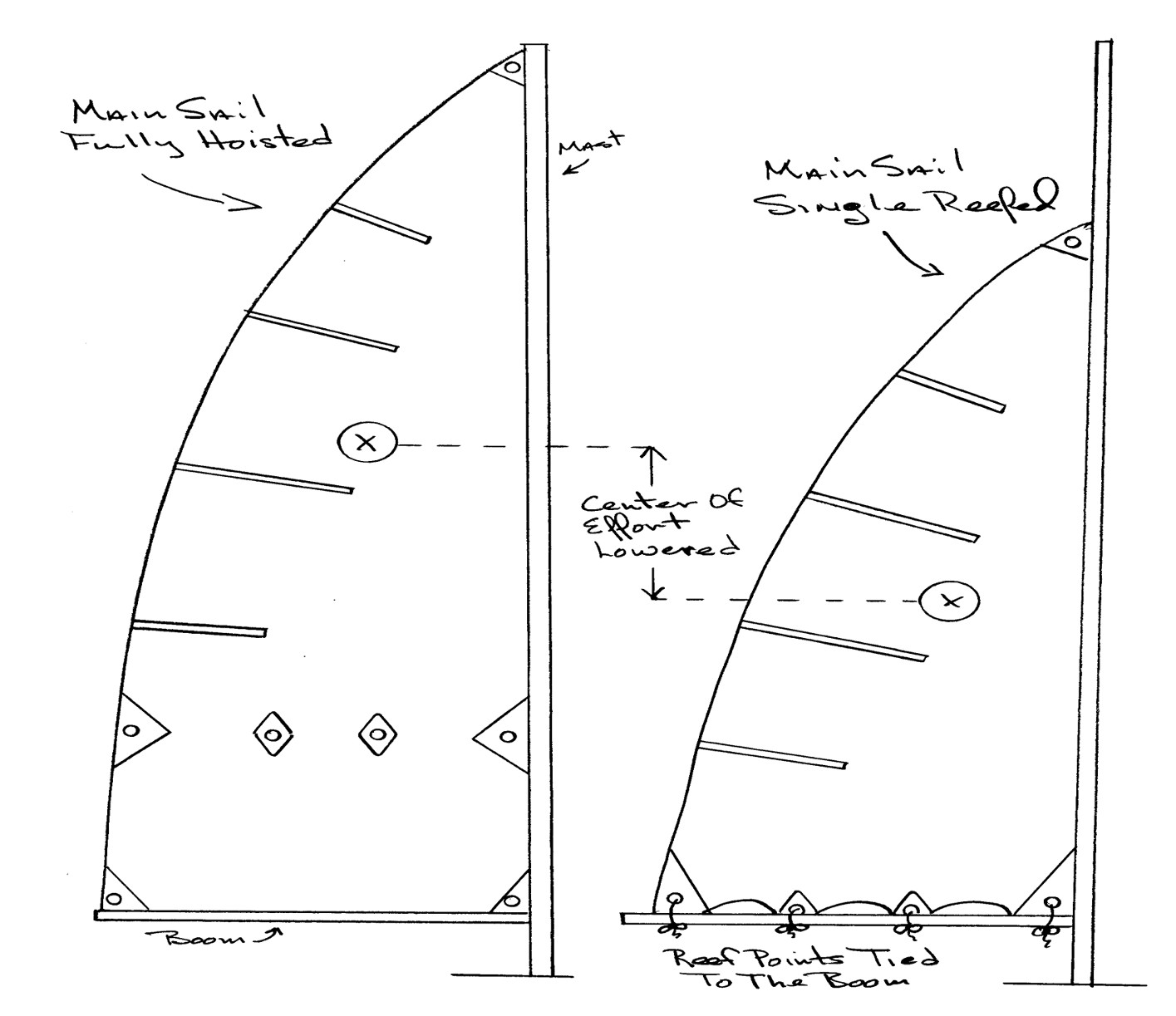
For me (and I suspect on most boats) it is easier to tuck a reef in the mainsail; especially if all the reefing gear is already installed are ready to go.

When I first got Snickerdoodle, she was rigged with "jiffy reefing" gear and all of the halyards, reefing lines, et al were led to the mast at about the height of the boom.   
 The first time I had to reef, I went forward on the cabin top to the mast.  Just as I was about to begin tucking in the reef, the person steering lost control of Snickerdoodle and we began to do snap spins uncontrollably.  That event (after dousing both main and jib, and then motoring back to the marina) was what convinced me to lead all of the halyards, sail control lines, reefing lines, etc. back to the cockpit.
The first setup that I rigged was for a single first reef using a single line system.  It worked OK and I subsequently added a single line for the second reef.
I have used this system for several years and like it fairly well.  The problem is that the single line tends to pull the luff edge of the sail down to the boom first... leaving the leach portion with quite a bit of friction to overcome.  
So, this spring I have re-rigged the reefing system to a double-line setup on both first and second reefs.  Yes, that did mean that there are two more reefing lines to keep track of.  But, I have color-coded the lines (red - first reef; blue - second reef).  Now the luff edge comes down smoothly as before - and the leach line does as well.

 The picture above shows only the first reef.  But, trust me, there are two reefs rigged aboard Snickerdoodle.  Now I can easily tuck in a reef in less than a minute - - and never have to leave the cockpit.


Tuesday, February 18, 2020

Chart Thoughts

Here it is the middle of February.  Snickerdoodle has been in her winter slip and tarps since November.  I am in my upstairs office and daydreaming about sailing.  I started thinking about using nautical charts to find my way around unfamiliar waters..... and the dangers of over-confidence when using those charts.
There is so much information that it is easy to overlook something that might be important.  So, what are a couple of the really important things to look for when first putting the new chart down on the chart table to plot a course or pre-plan a weekend sail?
One of the first things is to check to see what system of measurement is being used on your chart to display the depth of the water (soundings).  There are lots of numbers all over the water portion of the chart that show the depth of the water essentially at low tide.  At high tide the water's depth is deeper than the number indicates.  In the United States we use a different measurement for soundings than just about anywhere else in the world.  In pretty much the rest of the world, the measurements for water depth is done in meters (Metric).  Not so in the U.S.  In the U.S. for fresh water the soundings are done in feet.  So the water depths for the chart for Pend Oreille Lake are stated in feet.
For salt water regions of the U.S. the water depth is done using Fathoms (6-foot units).  So the chart for Puget Sound shows water depths in Fathoms.  The sounding information is noted at the bottom of the chart and often at the top of the chart as well.  BTW - a Meter is roughly 39.5 inches.  I generally figure a Meter to be a long three feet.  Snickerdoodle draws 4 feet empty and about 4.5 feet loaded.
Another important indicator on the chart is the Compass Rose.  This is a double circle of numbers indicating the degrees counted around the compass from 0 (North) to 359 (one degree west of north).  East is 090; South is 180;  and West is 270. The reason there are two circles of numbers is that the outer circle represents the compass as it shows True or geographic North (the North Pole on a globe).  The 0 has a line through it and a star that indicate the True North direction to the geographic north pole.  The inner circle of numbers represents the magnetic compass that shows the direction to the magnetic north pole.  For most places on the earth, True North and magnetic north are not exactly the same.  The inner (magnetic) circle shows the 0 with a line and an arrow pointing to the magnetic north pole.  In the example above, the magnetic north pole is 19.45 degrees east of True North.
It is important to realize this and remember that your compass will correspond to the inner circle - - NOT the outer one.  You can imagine that if you plotted your course to your next waypoint using the outer circle to find the course and then followed your compass with that course.  You would be steering your boat in the wrong direction.  Let's say that you figured your new course to be 040 using the outer ring of numbers and then steered 040 using your compass as reference.  Your actual True course would be 059.45.  That could get you in real trouble.  So, be certain to remember to use the inner circle if you are going to actually sail by compass numbers.

Is it important to have a chart and know how to use it?  Well, yes.  Here is a photo that I shot one day on Lake Pend Oreille when there was truly limited visibility of a quarter mile or less.  My chart and compass were invaluable finding my way home to Bayview without hitting anything or anybody.


Tuesday, December 17, 2019

Torqeedo Electronics

Several years ago, I decided to decrease my carbon footprint and replaced my gasoline-powered Mercury outboard with an electric outboard - - a Torqeedo.  The Torqeedo is powered by a battery bank that has 24 DC volts.  To accomplish this, I wired two group-27 12-volt batteries together in a series to generate the needed 24 DC volts. 
There was plenty of room in the fuel locker located under the portside cockpit seat.
The installation went as planned... including the hard-wiring in of a smart charger to keep the battery bank ready and fully charged.
The only drawback to the system is that while there is enough amps in the battery bank to motor from Bayview to Sandpoint (~30 nm) at about 3 knots, to go any faster will draw down the batteries quite quickly.  And, the faster I want to go, the faster the batteries are drawn down.  So, a couple years ago, I decided to put a second battery bank in the boat...  but, where to put two more batteries was a tough decision.  I finally decided to put the new battery bank (again two group-27 batteries and smart charger) under the cockpit sole.  There was enough room for a custom-made battery box and for the smart charger.
The second battery bank has been just what I needed.  And, no more worries about running out of "juice" on a long motor.
Last summer I added a "Off-1-Both-2" battery switch and a battery monitor that shows both the amount of charge (volts) and the amp draw for the battery bank being used.  Both of these are mounted on the inside of the transom. 
I could not be happier.
This is the schematic view of the whole system... not to scale...  The next decision is whether to try to figure out a solar charging system for days when I won't be able to plug into shore power to recharge... or if I should invest in a small Honda gen-set.
All-in-all, I am quite pleased with the Torqeedo and the whole outboard system that I now have.  It is quiet, and has no gas fumes.  Plus the outboard itself only weighs about 40 lbs. So, it easy to take off the bracket and put inside the boat for winter storage... and back on next spring.